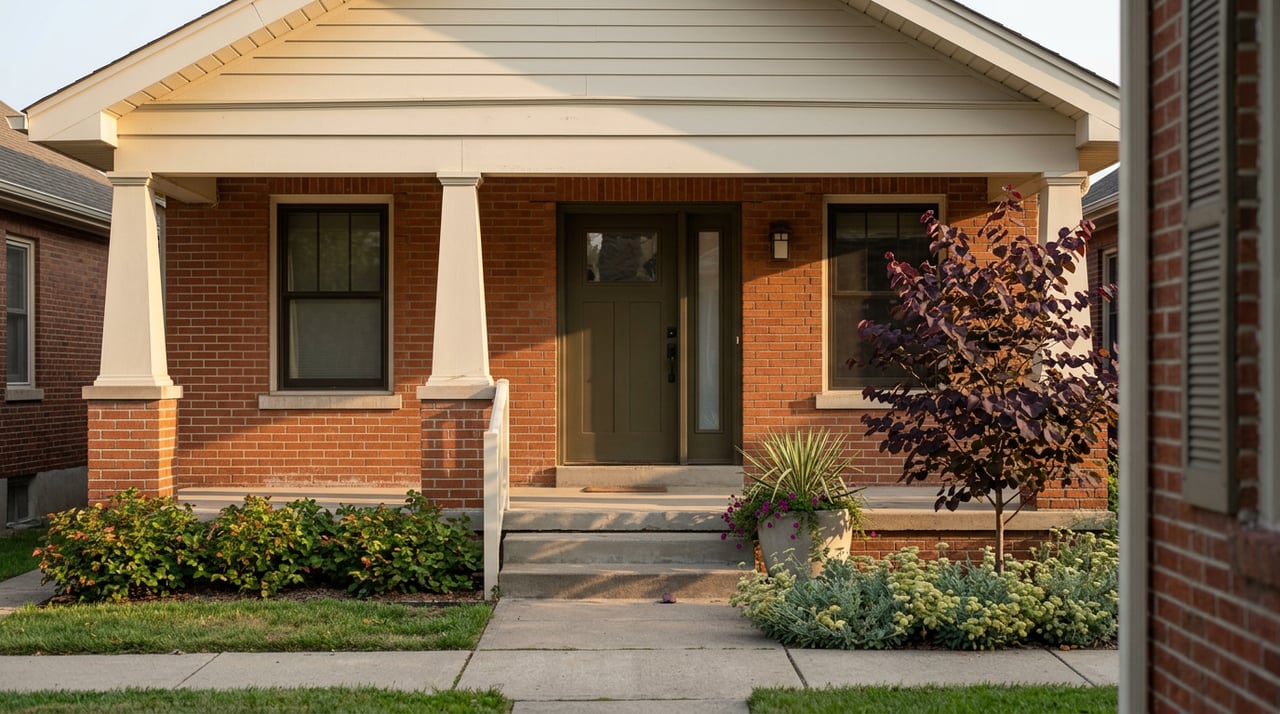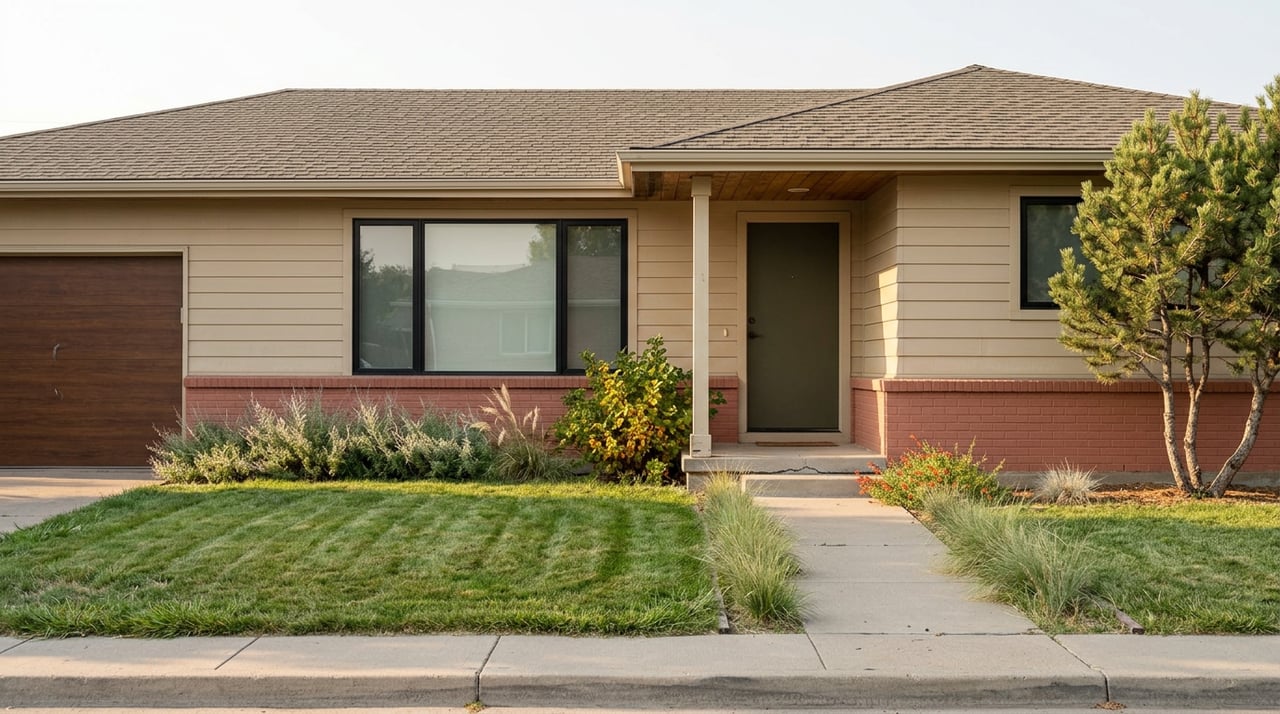
A buyer falls for one of the 170 Cliff May homes tucked into Denver's Harvey Park neighborhood, writes a competitive offer, and gets a mortgage commitment lined up without much drama. Then the appraisal comes back low. Not wildly low, but low enough that the loan officer starts asking questions the buyer can't answer, because the house they fell for isn't really being compared to itself. It's being compared to the brick ranch two doors down that shares a zip code and a decade of construction, but nothing else that made the offer worth writing in the first place.
This is the pattern that shows up again and again for buyers and sellers moving through Colorado's only Cliff May enclave, and it's the reason the neighborhood's published median price tells you less than it seems to. Harvey Park looks like one of Denver's better bargains on paper. The per-square-foot math says something closer to a premium that the lending system hasn't figured out how to price yet.
What "Colorado's only Cliff May neighborhood" actually means
Cliff May is the architect credited with popularizing the California ranch house, and in the early 1950s he partnered with architect Chris Choate on a patented, panelized prefab system meant to bring his design language to buyers who couldn't commission a custom home. Local builders across the country licensed the system and put up their own versions. In Denver, that builder was D.C. Burns Realty and Trust, run by Franklin Burns, and the model homes opened at Lowell Boulevard and Harvard Avenue in November 1954. Construction continued through 1956, producing 170 of these homes concentrated in Harvey Park, a number that hasn't grown since and never will, since no other Colorado neighborhood carries the same license.
That scarcity is the whole premise of the neighborhood's appeal to architecture buyers. It's also the thing an automated valuation model has no way to weigh, because scarcity isn't a line item on a comparable sales grid.
What the median price doesn't tell you
In June 2026, Harvey Park homes carried a median list price of $479,000, down 18 percent from a year earlier. Set next to Denver's broader single-family detached median of $660,000 for July 2026, reported by the Denver Metro Association of Realtors in its August update, that looks like a straightforward affordability story. Southwest Denver, less money, same city.
The per-square-foot numbers complicate that story considerably. Harvey Park's median list price per square foot in June 2026 was $405. Across Denver overall, the median sale price per square foot over the three months ending in May 2026 was $359, according to Redfin's market data. Harvey Park is trading at a higher rate per foot than the city it sits inside, even though the total sticker price reads as a discount.
The explanation isn't mysterious once you know the housing stock. Cliff May's original designs were compact by design, some as small as 850 square feet before later additions. A lower total price on a smaller footprint isn't the same thing as a cheaper house. It's a smaller house commanding a real premium for its architecture, expressed in the only unit that actually captures it.
Why the appraisal doesn't see the same house you do
This is where the friction shows up for anyone financing a purchase. One Denver-based restoration specialist who has personally renovated and sold dozens of these homes has described the difference between buying inside the true enclave and buying a one-off Cliff May sitting just outside its boundary. Every house on the block sharing the same design pedigree pulls value upward as a set. A single Cliff May surrounded by conventional ranches has to lean on the specialist's own judgment about what makes it different, because there's no clean comp a few doors down. In one case, an appraisal on a home just outside the enclave boundary came in roughly $90,000 under contract, despite sitting on a private park with a dead-end street, features an appraiser's grid has no field for.
The same specialist has pointed out that reproducing an original tongue-and-groove ceiling with exposed beams today would run close to $100,000 in materials and labor alone, a cost that historic sales data simply doesn't capture when the appraiser is working from a database of recent closings rather than a construction estimate.
None of this means these homes are overpriced or that financing them is unusually risky. It means the paperwork moves slower than the market does, and buyers who don't anticipate that gap are the ones most likely to get surprised at the worst possible moment in a transaction.
The Loretto Heights wildcard
Just south of the Cliff May enclave, inside the broader Harvey Park South neighborhood, sits the 72-acre former Loretto Heights College campus. Denver's Loretto Heights Area Plan, led by developer Westside Investment Partners, is converting the historic site into a mixed-use district anchored by preserved landmark buildings. The Pancratia Hall Lofts, a restored 1929 dormitory, reopened in 2022 with 74 income-restricted apartments. The next major piece is the May Bonfils Stanton Theater, a 750-seat venue that Denver Arts & Venues is renovating with $45 million in voter-approved RISE Bond funding from 2021 and an additional $4 million in 2025 Vibrant Bond funding for a new parking structure, with an inaugural season targeted for 2027. The most recent community update on the project took place on June 23, 2026, according to Denver Arts & Venues, and included parking structure renderings and an operating model decision for the venue.
District 2 Councilman Kevin Flynn has represented the area through the project's approvals and has framed it as an opportunity to build something Southwest Denver hasn't had, a mid-size cultural venue serving the neighborhood directly rather than downtown audiences.
None of this shows up in a comparable sales report yet, because public investment in a theater and a parking structure isn't a closed transaction. But it's the kind of amenity buildout that tends to move a neighborhood's baseline over a multi-year horizon, and it's landing on the doorstep of a housing stock that's already carrying more per-square-foot value than the appraisal system currently recognizes.
What this means if you're comparing neighborhoods
| Metric | Harvey Park (Cliff May enclave) | Denver metro, single-family |
|---|---|---|
| Median list price | $479,000 (June 2026) | $660,000 (July 2026, DMAR) |
| Median price per square foot | $405 (June 2026, list) | $359 (3 months ending May 2026, sale) |
| Original construction | 1954 to 1956 | Mixed vintage |
If you're a buyer drawn to Harvey Park for the architecture rather than just the price tag, the practical move is to build your appraisal case before you're under contract, not after a low number lands on your desk. That means pulling sales from inside the enclave specifically, not the surrounding blocks, and documenting the specific features an automated model won't catch on its own, from post-and-beam construction to original clerestory glazing. A lender working from generic comps has no reason to go looking for that context unless someone hands it to them.
If you're selling one of these homes, the same logic runs in reverse. A listing agent who understands the difference between a Cliff May original and a standard 1950s ranch can put together documentation that gives an appraiser something concrete to work with, rather than leaving the number to default toward the neighborhood average.
Either way, the published median price is a starting point, not the whole picture, and in a pocket of the market this specific, the whole picture matters more than usual.
A few questions worth answering directly
Are all 170 Cliff May homes still in original condition? No. Many have been renovated over the decades, ranging from light cosmetic updates to full restorations that preserve the original post-and-beam structure and glass walls. A smaller number have seen additions, including at least one model expanded from its original 850-square-foot footprint into a larger floor plan.
Is the Cliff May enclave the same thing as Harvey Park? Not exactly. Broader Harvey Park runs from West Jewell Avenue to West Yale Avenue and South Federal Boulevard to South Sheridan Boulevard. The Cliff May homes themselves sit within a smaller footprint inside that boundary, generally described as running between Iliff Avenue and Vassar Avenue, and Osceola Street to Lowell Boulevard.
Will the Loretto Heights project raise home values in Harvey Park itself? It's reasonable to expect some spillover effect as the theater and surrounding retail come online, but the project has moved in phases over several years already, and the theater's 2027 target season means the most visible piece of the plan is still ahead rather than behind.
If you're weighing Harvey Park against other pockets of Denver, Lakewood, or the broader South and West Metro, the numbers rarely tell the whole story on their own. Petrone Properties works through exactly this kind of comparison with buyers and sellers across Littleton, Denver, Highlands Ranch, and the surrounding communities every week. If you want a clearer read on what a specific price actually buys in a specific pocket of the market, request a free home valuation or take a look at the full Denver neighborhood guide to start comparing.